Hire a discovery-first automation consultancy before you sign anything, and start with a free assessment, not a full proposal. If your team spends 10 hours a week on manual data entry or invoice processing, that’s roughly $15,000 a year in wasted wages at a modest hourly rate. Throughline Automation offers a free 30-minute automation assessment as the low-risk first step.
TL;DR:
- Most automation projects in Australia cost between $10,000 for strategy-only work and up to $200,000 for full integration, depending on complexity.
- Typical project duration is three to five months, with a structured 90-day process that includes discovery, build, and handover phases.
- A proper workflow audit should identify which manual tasks are the most costly and provide detailed ROI estimates based on staff wages.
- The best consulting firms prioritize a discovery-first approach, have industry-specific experience, and avoid guessing by offering fixed prices after initial assessment.
- The fastest automation wins involve rules-based tasks like invoice processing, onboarding, and reporting, with quick adoption when staff understand the benefits.
Table of Contents
- What do workflow automation consulting firms in Australia actually do?
- How do you choose the right workflow automation consultancy?
- Why Throughline Automation fits mid-sized Australian businesses
- How long does an automation project take, and what does it cost?
- What should your IT team check before signing?
- Throughline team perspective: common mistakes and quick wins
- Book a free 30-minute automation assessment
- Sources
- FAQ
What do workflow automation consulting firms in Australia actually do?
Good consultancies do four things, in order: audit, strategy, build, and handover. Skip any of these steps and the project usually fails.
The workflow audit comes first. A proper audit maps your current process step by step. It shows where time gets lost, and puts a dollar figure on it. You should get a document showing which tasks cost the most staff hours, not just a verbal opinion.
Strategy comes next. This is where the consultancy tells you what to automate, in what order, and why. Expect three things in a strategy document:
- ROI projections tied to specific tasks, not vague productivity promises
- A technical plan showing what connects to what (your CRM, your accounting software, your payroll system)
- Clear roles: who owns the automation once it’s live, and who gets trained
Then comes the build. This is the actual integration and automation work: connecting systems, building the workflow, and testing it against real data before it touches your live operations. A consultancy that jumps straight to “build” without an audit is guessing at your priorities.
Handover matters more than most buyers expect. You want documentation, a trained internal contact, and a support plan, not just a working system nobody in your business understands.
The use cases that pay for themselves fastest are the boring ones: invoice processing, staff onboarding paperwork, monthly reporting, and support ticket triage. These are high-volume, rules-based tasks where a human is doing the same ten steps every single time. SME adoption data shows content generation and data analytics lead current AI use in Australian small businesses, which lines up with where the fastest, lowest-risk wins tend to sit.
How do you choose the right workflow automation consultancy?
Five criteria matter more than the rest. Rank any shortlist against these before you look at price.
- Discovery-first process. They audit before they quote. If a firm gives you a fixed price before understanding your workflows, that’s a guess, not a plan.
- Delivery capability, not just strategy slides. Ask who actually builds the integration. Some firms are strategy shops that hand the technical work to a third party.
- Industry experience. A firm that has automated onboarding for an NDIS provider understands compliance constraints a generic vendor won’t.
- Integration expertise with your existing tools. Xero, HubSpot, and your payroll system all have quirks. Ask for specifics, not “we work with anything.”
- Data residency and security practices. Where does your data sit, and who can access it during the build?
Here are seven questions worth asking on a first discovery call:
- Can you timebox the discovery phase and tell me what it costs?
- What does a sample audit or process map actually look like?
- Can I speak to a reference client in a similar industry?
- What’s your pricing model after discovery, fixed or hourly?
- Who owns the intellectual property in the automation you build?
- What support is included after handover, and for how long?
- Under what conditions would you tell me not to automate a process?
That last question is the one that separates good consultants from opportunistic ones. A quality signal worth trusting is a consultant willing to say a process isn’t worth automating after discovery, rather than automating everything to justify the invoice.
Watch for red flags on that first call: vague answers about pricing, no willingness to show a sample deliverable, or pressure to sign before discovery is even scoped.
Pro Tip: Score three shortlisted firms out of 10 on delivery capability, industry fit, and expected ROI. A firm that scores well on all three beats one that’s cheaper but weak on fit.
Why Throughline Automation fits mid-sized Australian businesses
Throughline Automation runs a discovery-first process. It doesn’t ask you to rip out Xero, your CRM, or your payroll platform. It automates the manual work sitting on top of the software you already use, connecting to it through APIs and custom integrations rather than forcing a rebuild.
Typical clients are operations, finance, HR, and customer service leaders in organisations with 50 to 1,000-plus staff. That includes:
- Healthcare, aged care, and NDIS providers managing heavy compliance and admin loads
- Professional services firms buried in reporting and client onboarding
- Property and construction businesses handling repetitive documentation
- Recruitment agencies drowning in candidate and client admin
These are teams carrying a growing administrative load who don’t want to fix it by hiring more people.
Delivery runs through a defined 90-day transformation process: map the highest-cost manual workflows, build and integrate the automations, then hand over measurable time and cost savings. Mid-market automation projects in Australia commonly run three to five months from discovery to initial rollout, and can cut processing time by 30 to 50% on the workflows targeted.
Every engagement starts with a free 30-minute automation assessment. There’s no proposal, no commitment, just a conversation about where your team is losing the most hours.
When you’re comparing proposals, ask for the same things Throughline Automation builds into every engagement: a defined discovery process, industry-specific delivery experience, and fixed pricing once discovery is complete. Anything vaguer than that is a red flag.
How long does an automation project take, and what does it cost?
Expect three phases over roughly 90 days. Each phase has a clear deliverable, and each one should be signed off before the next starts.
| Phase | Duration | What you get |
|---|---|---|
| Discovery | Weeks 1 to 3 | Process map, prioritised use cases, ROI estimate |
| Build and pilot | Weeks 4 to 5 | Working automation tested on priority workflows |
| Scale and handover | Weeks 6 to 7 | Full rollout, documentation, staff training, support plan |
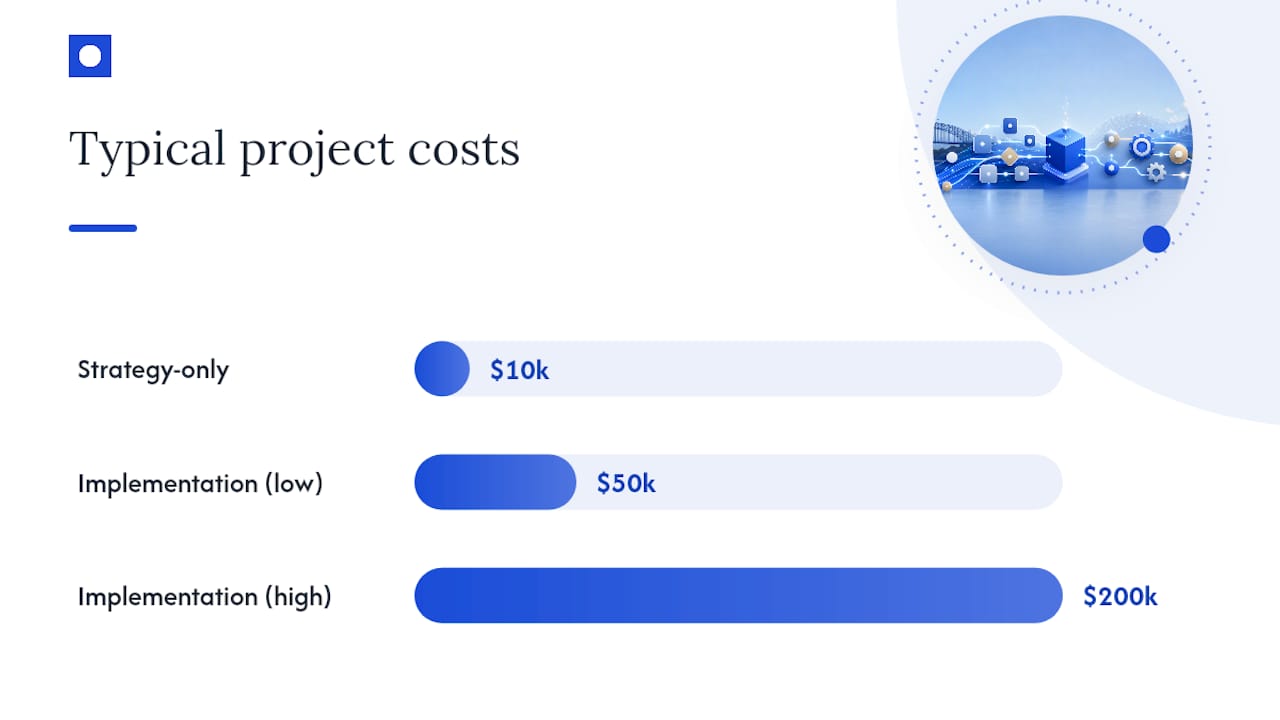
Costs vary with scope. Industry guidance puts strategy-only engagements at around $10,000, with full implementation projects commonly ranging from $50,000 to $200,000 depending on how many systems need integrating and how much data clean-up is required. The biggest cost drivers are the number of integrations, any custom AI work, and messy source data that needs fixing before automation can run reliably.
When you’re reading a proposal, check the ROI assumptions against your own numbers. If a vendor claims a saving without showing the hours-per-week calculation behind it, ask for the working. A legitimate proposal should let you rebuild the ROI figure yourself from your own staff costs.
Ask about ongoing support costs too. Some firms bundle three months of support into the build price; others charge separately. Fixed pricing after discovery is the standard to hold vendors to, so there are no surprises once the build starts.
What should your IT team check before signing?
Most Australian businesses run some combination of Xero, HubSpot, Employment Hero, a CRM, and a pile of spreadsheets holding the process together. Before you sign with any consultancy, get your IT lead to check these:
- Does the firm have documented experience integrating with your specific accounting, payroll, and CRM tools?
- Is data hosted in Australia, or does it cross borders during processing?
- How is data encrypted in transit and at rest, and who has access during the build?
- Is the automation built on a low-code platform your team can maintain, or custom code that only the vendor understands?
- Will you receive documentation detailed enough for a new staff member to take over support?
An integration-first approach that keeps your existing software and automates on top of it is standard practice in Australia, and for good reason. Ripping out a working accounting system to fit a new automation tool creates risk and downtime you don’t need. Keeping the systems you already use shortens time to value because your staff aren’t relearning software on top of learning a new process.
Any consultant handling personal or health information also needs a clear answer on how they meet Privacy Act obligations, particularly around data storage and third-party access during the build.
Throughline team perspective: common mistakes and quick wins
The biggest mistake businesses make is trying to automate everything at once. Pick the two or three highest-volume manual tasks first, prove the ROI, then expand.
Three quick wins consistently return value within weeks: automated invoice matching, automated onboarding paperwork, and automated weekly reporting. All three are high-volume, low-complexity, and easy for staff to see working almost immediately.
Adoption fails when staff aren’t told why a process changed. A five-minute explanation of what the automation does, and what it frees them up to do instead, beats a lengthy training manual nobody reads. Automation more often expands what existing staff can handle than it replaces roles, and that message needs to reach the team doing the work, not just the manager who signed the contract.
— Throughline Team
Book a free 30-minute automation assessment
A discovery-first automation consultancy can help reduce manual hours and identify where automation saves the most time without a system rebuild or adding headcount. A free 30-minute automation assessment can reveal your highest-cost manual workflows.
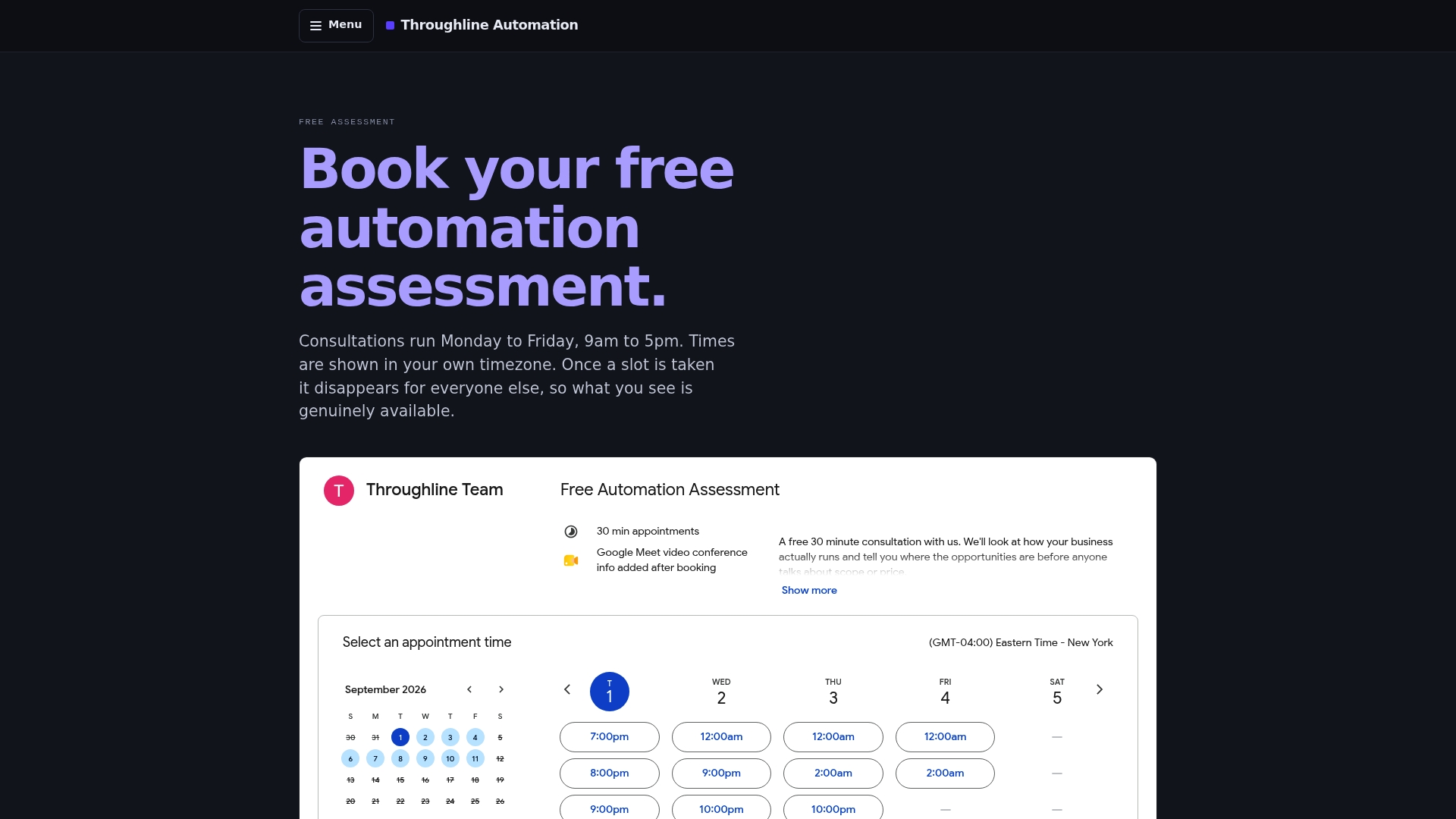
There’s no proposal, no pressure, just a conversation about where your team’s hours are going. You’ll walk away knowing which two or three tasks are worth automating first, and roughly what kind of saving is realistic for your business. If you want a rough number before the call, the automation ROI calculator gives you a starting estimate based on staff hours and hourly cost.
Book your free automation assessment and find out what a 90-day transformation could look like for your operations, finance, HR, or customer service team.
Sources
- Business process automation for Australian companies
- How to choose an AI consultant in Australia: a business guide (2026)
FAQ
What does a workflow automation consultancy actually deliver?
A process audit, an automation strategy with ROI projections, the technical build and integration work, and handover documentation with staff training.
How much does automation consulting cost in Australia?
Strategy-only work often starts around $10,000, while full implementation projects commonly range from $50,000 to $200,000 depending on integrations and data complexity.
How long does a typical automation project take?
Most mid-market projects run three to five months from discovery through to initial rollout, with Throughline Automation using a defined 90-day transformation process.
Will automation replace our existing software like Xero or our CRM?
No. A good consultancy automates the manual workflows running on top of your existing systems rather than replacing them, which reduces risk and speeds up delivery.
What’s the fastest way to find out if automation is worth it for us?
Book a free 30-minute automation assessment with Throughline Automation to identify your highest-cost manual tasks before committing to any paid engagement.