Pick a partner that scopes before it builds, shows you real production systems (not a demo), and hands over full documentation at the end. That’s the whole test. If a vendor fails any of those three, keep looking. Before your first call, work out how many hours a week your team loses to manual tasks and multiply by your hourly cost. That number becomes your business case.
TL;DR:
- Vendors should demonstrate real production systems with monitoring and error handling, not just scripted demos, and provide full documentation at handover.
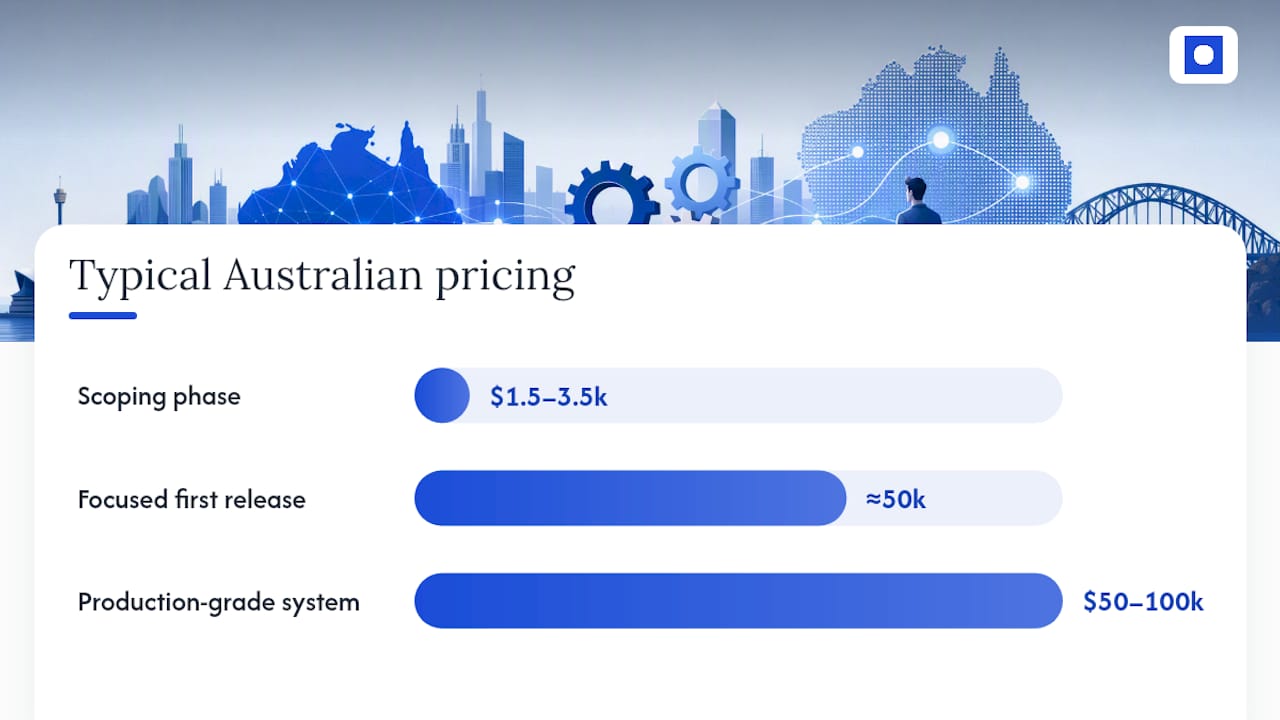
- A proper scoping process involves a paid, two-week engagement costing around $1,500–$3,500 AUD, resulting in a clear, ranked automation plan and handover details.
- Avoid vendors who skip scoping, cannot explain data security, or cannot provide references from similar businesses, as these are red flags.
- Focus on one well-understood workflow and quantify manual hours lost before evaluating vendors, rather than relying solely on features or slides.
- Throughline Automation offers a free 30-minute assessment to explore potential ROI, emphasizing real systems, clear handover, and realistic project timelines.
Table of Contents
- Checklist: how to choose a business process automation partner in Australia
- What a proper scoping phase and pricing should look like
- Red flags to walk away from and questions to ask
- How Throughline Automation approaches this
- What actually matters when you’re choosing a partner
- Ready to see what automation could save you?
- Sources
- FAQ
Checklist: how to choose a business process automation partner in Australia
Score every vendor against the same criteria. Use this as a scoresheet on your first three discovery calls, and don’t sign anything until each row has a tick.
- Process fit. Ask the vendor to name one specific workflow, one process owner, and the hours it currently eats per week. If they can’t get specific in the first meeting, they haven’t listened.
- Delivery proof. Ask to see production systems, not scripted demos. A real system has monitoring, error handling and an audit trail; a demo has none of that, and vendors should be able to show you the difference.
- Integration capability. Confirm they can work with your existing software through APIs or middleware, and ask which platforms they’ve integrated with before.
- Security and data residency. For Australian businesses, this is non-negotiable. Ask where your data is hosted, how it’s encrypted, and how the vendor’s practices align with the Privacy Act and the Australian Privacy Principles.
- Measurement and ROI. Ask what hours saved, error reduction, or turnaround improvement they expect, and how they’ll measure it after go-live.
- Support and SLAs. Ask who fixes it when something breaks at 7pm on a Friday, and how fast they respond.
- Case evidence. Ask for references from businesses your size, in your industry, ideally with a similar systems setup to yours.
A handful of things separate a genuine partner from a vendor chasing a quick sale:
- They ask about your business before they mention their technology.
- They can point to systems running in production today, not a portfolio of screenshots.
- They talk about handover and documentation before you’ve even asked.
- They’re upfront about what they can’t automate yet.
- They quote a scoping fee instead of a build price on the first call.
Pro Tip: Score each vendor green, amber or red on every row above. Anyone with two or more reds doesn’t get a second call.
What a proper scoping phase and pricing should look like
A legitimate automation partner never quotes a build price after one conversation. They run a paid, time-boxed scoping phase first, and hand you a costed plan at the end of it.
That scoping phase should produce three things: a scored list of automation opportunities ranked by value, a plan covering infrastructure and security, and a training and handover plan showing how you’ll own the system once it’s live, as outlined in KUMO’s automation partner checklist.
What Australian pricing usually looks like:
- A focused first release covering one workflow with two or three integrations usually costs in the mid-range tens of thousands of Australian dollars.
- A production-grade system with custom interfaces, multiple integrations and full monitoring: often $50,000–$100,000, per the same KUMO checklist.
Push for a contract where the scoping fee is credited against the build cost if you proceed. This keeps the vendor motivated to scope accurately rather than pad the estimate, and it protects you from open-ended hourly billing once the project starts.
At handover, insist on documentation, runbooks, access to any code or configuration repositories, and training for your staff. A support contract with no transfer terms is a warning sign on its own.
Red flags to walk away from and questions to ask
Some warning signs show up in the first five minutes of a call.
Walk away if a vendor:
- Only shows you demos, never production systems.
- Skips scoping and jumps straight to a fixed build price.
- Can’t explain where your data is hosted or how it’s secured.
- Gives you no handover plan when you ask what happens after launch.
- Can’t name a single client in your industry or of your size.
Ten questions worth asking on the first call:
- Can you show me a production system you’ve built, not a demo?
- What exactly will we own once this is built?
- How does your scoping process work, and what does it cost?
- Where is our data stored, and how is it encrypted?
- What happens if the system breaks after hours?
- Who actually builds this: your team, or a subcontractor?
- What’s your estimate for hours saved per week?
- What’s included in the handover package?
- Can we speak to a reference client in a similar industry?
- What happens if we want to exit or switch providers later?
Pro Tip: Mark each answer green, amber or red as you go. A vendor scoring mostly green on these ten questions is worth a second meeting; anything else, move on.
How Throughline Automation approaches this
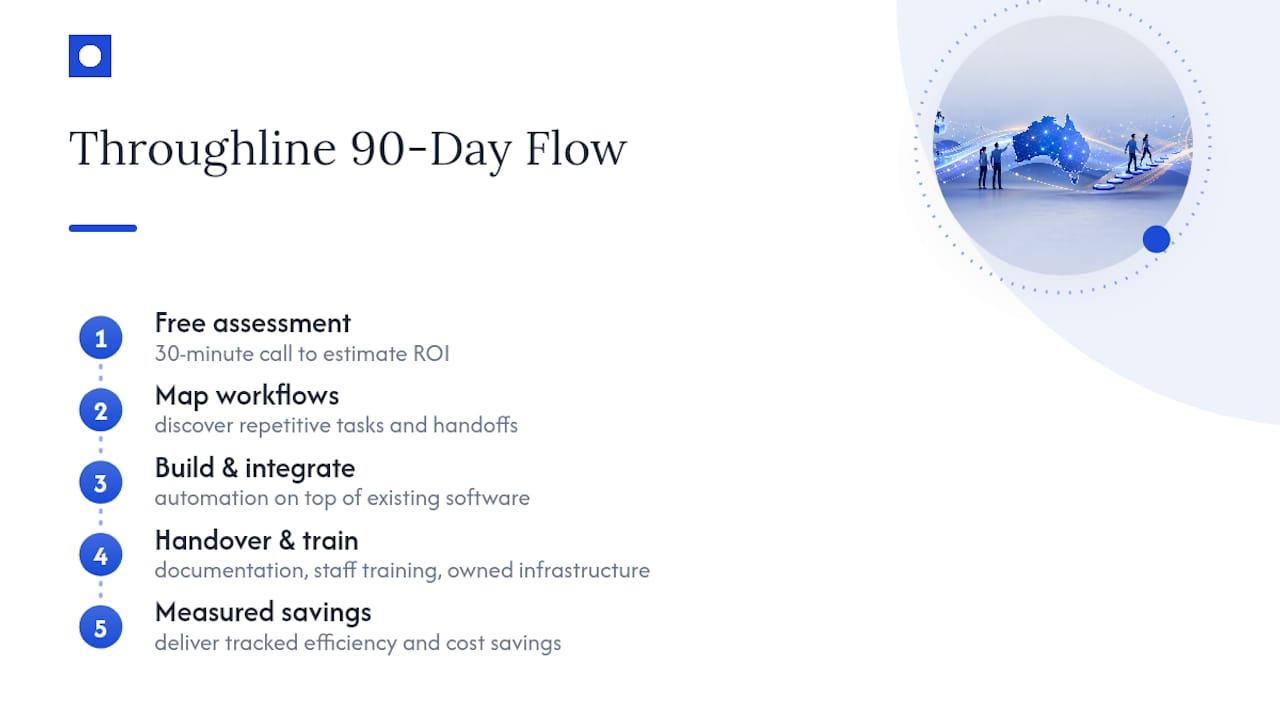
A good automation partner runs every engagement through a defined 90-day transformation to map workflows, build and integrate automations, then hand over measurable savings.
They automate repetitive work sitting on top of the software you already use, including data entry, invoice workflows, internal handoffs, reporting, onboarding admin, and customer service workflows.
At handover, you get full documentation, staff training, and infrastructure you own, not a system locked to us. Every engagement starts with a free 30-minute automation assessment and you can estimate your own potential ROI before that call.
What actually matters when you’re choosing a partner
Most advice on this topic focuses on technology—such as which platform, which AI model, or which integration framework. That’s the wrong starting point.
The businesses that get burned aren’t the ones who picked the “wrong” software. They’re the ones who picked a vendor that skipped scoping, built something nobody could maintain, and disappeared after the invoice cleared. A scoping phase that’s credited against the build isn’t a nice-to-have. It’s the single clearest signal that a vendor’s incentives match yours.
Here’s what we’d prioritise first: pick one painful, well-understood workflow and put a real number on it. Hours per week, times your hourly cost. That number does more to focus a vendor conversation than any feature checklist. Then judge every partner on whether they can show you something running in production, not a slide deck.
The rest, contracts, SLAs, support windows, matters. But it’s secondary to that first, honest number.
— Throughline Team
Ready to see what automation could save you?
You don’t need to commit to a project to find out what manual work is actually costing you. Unlike a full agency engagement or a DIY automation platform you’d have to configure yourself, Throughline Automation starts with a free, no-obligation conversation focused entirely on your numbers.
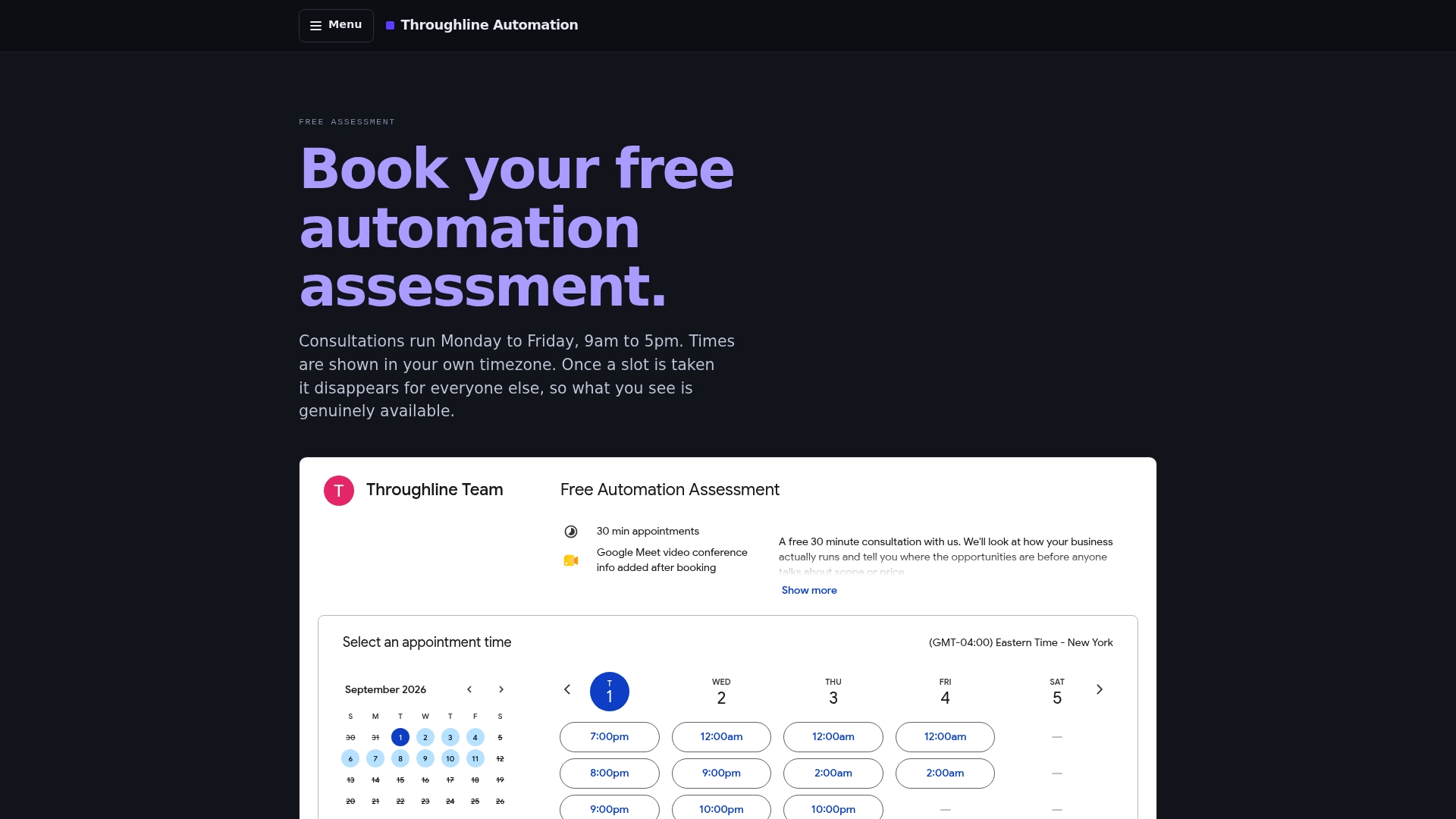
Book a free 30-minute automation assessment and come with three things: the one workflow that frustrates your team most, the systems it currently touches, and a rough guess at hours lost per week. We’ll tell you honestly whether automation makes sense for that process, and if it does, what the 90-day transformation would look like for your business. No pressure, no fixed-price pitch on the first call. Just a straight answer about whether the numbers stack up.
Sources
- How to choose an AI consultant in Australia: a business guide (2026)
- AI business process automation company checklist (2026) | KUMO
- Artificial intelligence consulting companies vs automation agencies: How Australian SMBs should choose
FAQ
Who are the leading business process automation providers?
There’s no single “best” provider for every business. The right partner depends on your industry, your existing systems, and whether you need a local team that understands the Privacy Act and Australian Privacy Principles, as outlined by Nexus Digital.
Which company is best for automation?
The best fit is the one that scopes your specific workflows first, shows you production systems rather than demos, and gives you a clear handover plan. Throughline Automation follows this model through its 90-day transformation process.
What are the core business processes worth automating first?
Most businesses see the fastest returns automating data entry, invoice and accounts payable processing, internal approvals and handoffs, reporting, and onboarding or recruitment admin, since these tasks are repetitive, rules-based and easy to measure in hours saved.
How long does it take to see results from automation?
Expect roughly four to twelve weeks for initial results once a project starts, with a time-boxed pilot and clear acceptance tests, according to Nexus Digital’s guidance.
Should I choose a local or offshore automation partner?
For systems touching sensitive operational data, a local partner is the safer choice because of data residency, time zone alignment and accountability, as SyncStream notes. Offshore-only delivery is reasonable only for narrow, low-stakes tasks.