If manual admin is eating 15 hours a week across your team, hiring a business process automation consultant in Melbourne is the fastest way to fix it. The right consultant maps your worst workflows, builds automations on top of the systems you already run, and hands over measurable savings. Book a free 30-minute automation assessment first. It tells you which processes cost the most and roughly what you’ll get back before you sign anything.
TL;DR:
- Most Melbourne automation consultants can build tailored solutions quickly, with a typical 90-day timeline from discovery to handover for high-volume processes.
- A clear assessment of manual process costs and potential savings should be completed before project scope and pricing are finalized, emphasizing the importance of a discovery phase.
- Automation efforts succeed best when targeting repeatable processes such as invoice processing or report generation, with measurable ROI based on hours and dollars saved.
- Confirm that data remains stored on Australian infrastructure and that the consultant has experience building actual automation, not just offering strategy advice.
- Expect to pay based on scope, with fixed, time-and-materials, or retainer models, and avoid fixed-price quotes prior to a thorough discovery to ensure accuracy.
Table of Contents
- What does a business process automation consultant actually do?
- How do you choose the right automation consultant?
- What happens during a 90-day automation transformation?
- What ROI should you actually expect from automation?
- What does an automation consultant cost in Melbourne?
- What’s the process from first call to finished project?
- How have Melbourne businesses used automation consultants?
- Is it easy to find a good automation consultant in Melbourne?
- Throughline Team perspective: the mistakes that cost the most time
- Book your free automation assessment
- Sources
- FAQ
What does a business process automation consultant actually do?
A business process automation consultant looks at how work moves through your business, finds the manual bottlenecks, and builds software to remove them. You don’t need to replace your existing systems. A good automation expert connects to them.
Here’s what’s typically on the table:
- Process discovery and mapping — walking through how a task actually happens today, step by step, before touching any code.
- RPA and bot builds — software robots that copy, key in, and move data the way a person currently does it manually.
- API integrations — connecting two systems (say, your CRM and your accounting software) so data flows without anyone re-typing it.
- Document automation — auto-generating invoices, contracts, offer letters, and reports from templates and live data.
- Report automation — pulling numbers from multiple systems into one dashboard, on schedule, with no manual copy-paste.
- Testing and ongoing support — checking the automation holds up under real conditions, then fixing it when your systems change.
Different teams feel this differently. Finance gets faster invoice processing and fewer AP errors. HR cuts onboarding paperwork and recruitment admin. Operations automates order processing and scheduling. Customer service gets faster case routing and automatic follow-ups.
The point of platform-agnostic delivery is simple: less disruption. Your team keeps using the tools they know. The custom business automation work happens underneath, not as a forced software migration.
How do you choose the right automation consultant?
Most business efficiency consultants in Melbourne sound similar on a website. The differences show up in the discovery call, if you ask the right questions.
Run through this checklist first:
- Track record on similar work. Ask for a real example, not a generic case study.
- Who actually builds it. Some firms sell strategy decks and outsource the build. Find out who touches your systems.
- How they measure results. If they can’t explain how they’ll track hours or dollars saved, they won’t be able to prove ROI later.
- Data residency and governance. Where does your data sit, and who can access it?
- Pricing model and IP ownership. Fixed price or time and materials? Do you own the automation once it’s built?
Ask these exact questions on the call:
- “Describe a similar project and its measured outcome.”
- “Who will be building the automation, specifically?”
- “How do you measure time and cost savings?”
- “Where will our data be stored, and who can access it?”
Pro Tip: Ask every shortlisted consultant to confirm their data centres are in Australia, such as AWS’s Sydney region, so your data stays under local compliance requirements. A vague answer here is a red flag on its own.
Watch for warning signs: no concrete implementation plan, all slides and no builders, pricing that stays vague past the first call, or hesitation about confirming data residency. A serious process improvement consultant will answer all four questions without flinching.
What happens during a 90-day automation transformation?
A short, structured timeline is what separates a real delivery plan from an open-ended consulting engagement. Here’s roughly what a well-run 90-day transformation looks like.
Weeks 1 and 2: Discovery. The consultant maps three to five of your highest-cost manual processes. They baseline current hours spent and cost, then rank the processes by likely return. You get a clear priority list, not a guess.
Weeks 3 to 8: Build and integrate. Work starts on the top one to three processes. The team builds the automation, integrates it with your existing systems, tests it against real data, and adjusts based on feedback from the people actually using it.
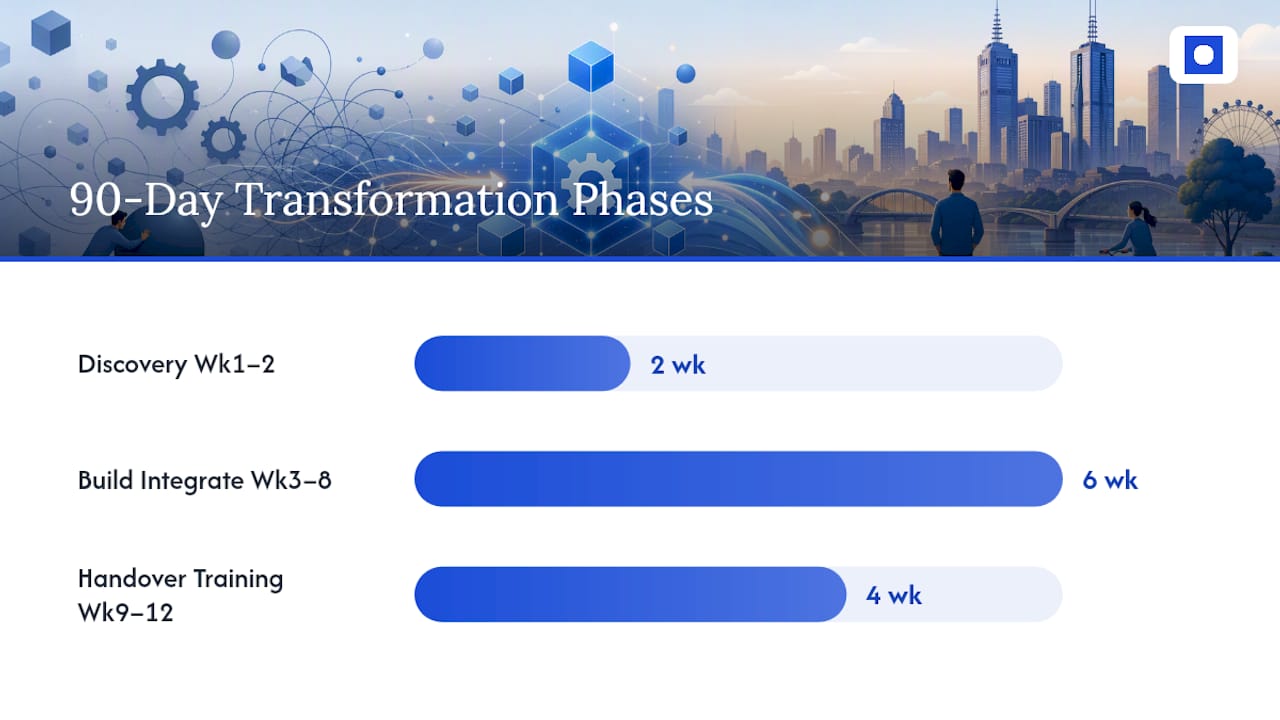
Weeks 9 to 12: Handover and training. Your staff get trained on the new workflow. KPI tracking goes live so you can see hours and dollars saved in real numbers. A short optimisation round follows once the automation is running on real volume.
By the end, you should have:
- Working automations running on your actual processes, not a demo.
- A measurement baseline plus a first-month savings estimate in hours and AUD.
- A written automation playbook covering how it works and how to extend it.
- An ongoing support plan for when your systems or processes change.
A short transformation like this only works if the project targets high-volume, repeatable processes with a baseline and KPI tracking set from day one. Try to automate everything at once and you’ll dilute the result across too many processes to measure any of them properly.
What ROI should you actually expect from automation?
Set your expectations with real numbers, not vendor promises. NAB’s research found 58% of Australian SMEs use AI to improve productivity, but only 22% report transformational efficiency and cost gains. That gap between “using the tech” and “seeing the transformation” is exactly where delivery quality matters.
The gap that matters: 58% of Australian SMEs use AI for productivity gains. Only 22% call the results transformational. The other 36% are paying for tools without redesigning the work around them.
EY’s analysis backs this up: buying technology alone doesn’t lift productivity. The value comes from redesigning how work actually happens and embedding automation into decisions, not bolting software onto a broken process.
The practical fix is simple. Take the hours your team currently spends on a manual task each week. Multiply by your loaded hourly labour cost. That’s your annual cost of doing it manually, in AUD. If a consultant’s automation reclaims most of those hours, you’ve got your payback figure. Aim for a first quarter payback on your quickest win, invoice processing or report generation are usually the fastest.
What does an automation consultant cost in Melbourne?
Pricing varies by scope, but most Melbourne-based automation consultants work on one of three models.
| Pricing model | How it works | Best suited to |
|---|---|---|
| Fixed-price project | One price for a defined scope, agreed after discovery | Clients who want budget certainty on 1 to 3 processes |
| Time and materials | Billed by hours or day rate as work progresses | Larger, evolving projects with shifting scope |
| Retainer or ongoing support | Monthly fee for maintenance and new automation requests | Businesses with recurring automation needs |
Most engagements start with a paid or free discovery phase before any fixed price is quoted, because no consultant can price a project properly without first mapping your processes. That’s exactly why a free 30-minute assessment matters: you get a rough scope and expected savings before committing budget.
Be wary of a consultant who quotes a fixed price on day one, before ever seeing your systems. That’s a guess dressed up as a number. A properly scoped fixed-price quote comes after discovery, once the consultant actually knows what they’re automating and what data quality they’re working with.
What’s the process from first call to finished project?
The path from enquiry to a working automation usually follows a consistent shape, even if the exact weeks shift slightly by project.
- Initial contact. You describe the problem, roughly how many hours it costs your team weekly.
- Free assessment call. A 30-minute conversation to identify your top automation opportunities and estimate potential savings.
- Discovery and scoping. The consultant maps your highest-cost processes in detail and prices the build.
- Proposal and sign-off. You get a scope, timeline, and price. You approve it.
- Build phase. The automation gets built and connected to your existing systems.
- Testing with your team. Real data, real users, adjustments made before go-live.
- Handover and training. Your staff learn the new workflow. Support arrangements are confirmed.
- Measurement and optimisation. Hours and dollars saved get tracked against the baseline set in discovery.
Most Melbourne engagements complete steps three through eight inside 90 days for a first, focused process. Larger organisations tackling multiple processes across finance, HR, and operations sometimes run several 90-day cycles back to back, one process group at a time, rather than one long undefined project.
How have Melbourne businesses used automation consultants?
Melbourne’s mix of professional services firms, healthcare and aged care providers, property and construction businesses, and recruitment agencies each carry a similar problem: growing admin load without wanting to add headcount to cover it.
The pattern that shows up across these sectors is consistent. Invoice processing and accounts payable are usually the first target, because the volume is high and the rules are consistent, which makes automation reliable quickly. Recruitment agencies and HR teams often automate onboarding paperwork and candidate screening admin next, since these tasks repeat for every new hire but rarely change in structure. Property and construction firms tend to focus on document generation and scheduling, where the same forms and confirmations get typed out over and over.
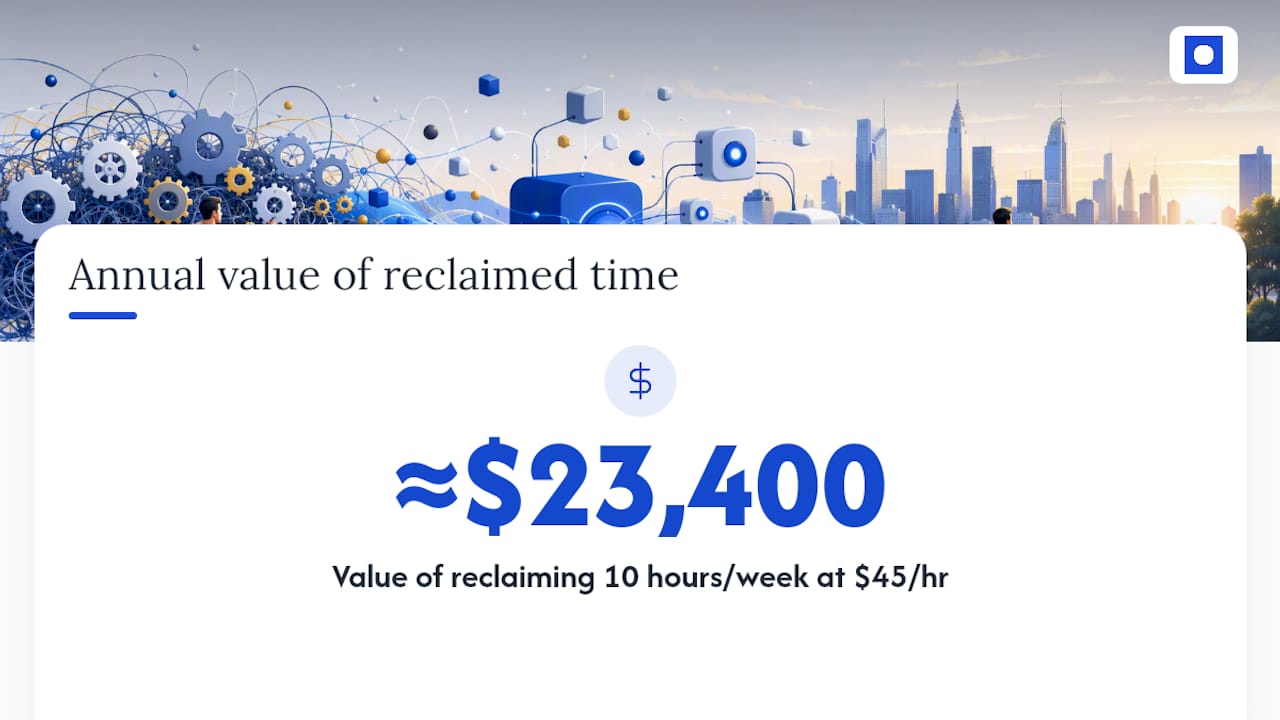
Australian small businesses commonly report spending 15 to 20 hours a week on admin tasks, with automation reclaiming 10 or more of those hours once it’s running properly. Scale that to a loaded hourly rate of $45, and 10 reclaimed hours a week is roughly $23,400 a year back into the business, before counting fewer errors and faster turnaround for customers.
The consistent theme across healthcare and professional services automation work isn’t the industry. It’s picking one high-volume process, automating it properly, and measuring the result before moving to the next.
Is it easy to find a good automation consultant in Melbourne?
Melbourne has a deep pool of automation talent thanks to its concentration of professional services firms, mid-size enterprises, and a strong technology sector. That’s good news and a trap in equal measure.
The good news: you’re not short of options. Melbourne-based consultants understand Australian Privacy Act obligations, work in your time zone, and can meet on-site if your process mapping needs face-to-face whiteboarding with staff. Local Melbourne workflow automation firms also tend to understand sector-specific quirks, aged care compliance, construction scheduling, recruitment volume spikes, better than an overseas provider working from a generic playbook.
The trap: plenty of firms in Melbourne’s crowded consulting market lean heavily on strategy and light on delivery. Workforce readiness for AI and automation in Australian businesses is not high, averaging low scores nationally, which means the gap between consultants who can talk about automation and those who can actually build and support it is wider than the market suggests. Availability also tightens toward financial year end, when finance teams push automation projects to close out the year, so booking a discovery call early gives you more room on the calendar.
Whether you use a local Melbourne-based automation expert or one operating remotely across Australia, the fundamentals stay the same: check they build as well as advise, and confirm your data stays on Australian infrastructure.
Throughline Team perspective: the mistakes that cost the most time
The biggest mistake we see is automating a broken process instead of fixing it first. Automation speeds up whatever you feed it, including bad handoffs and duplicate approvals. Data clean-up is almost always under-budgeted, and change management gets skipped entirely, which is why staff quietly go back to the old spreadsheet three weeks later.
The fastest wins are boring on purpose: invoice processing, standard report generation, simple onboarding flows. High volume, consistent rules, easy to measure. Multiply hours saved by loaded labour cost and you’ve got a business case that survives scrutiny.
— Throughline Team
Book your free automation assessment
You’ve seen what a proper 90-day transformation looks like and what it should cost. The next move is finding out what your own highest-cost manual processes are actually worth in hours and dollars.
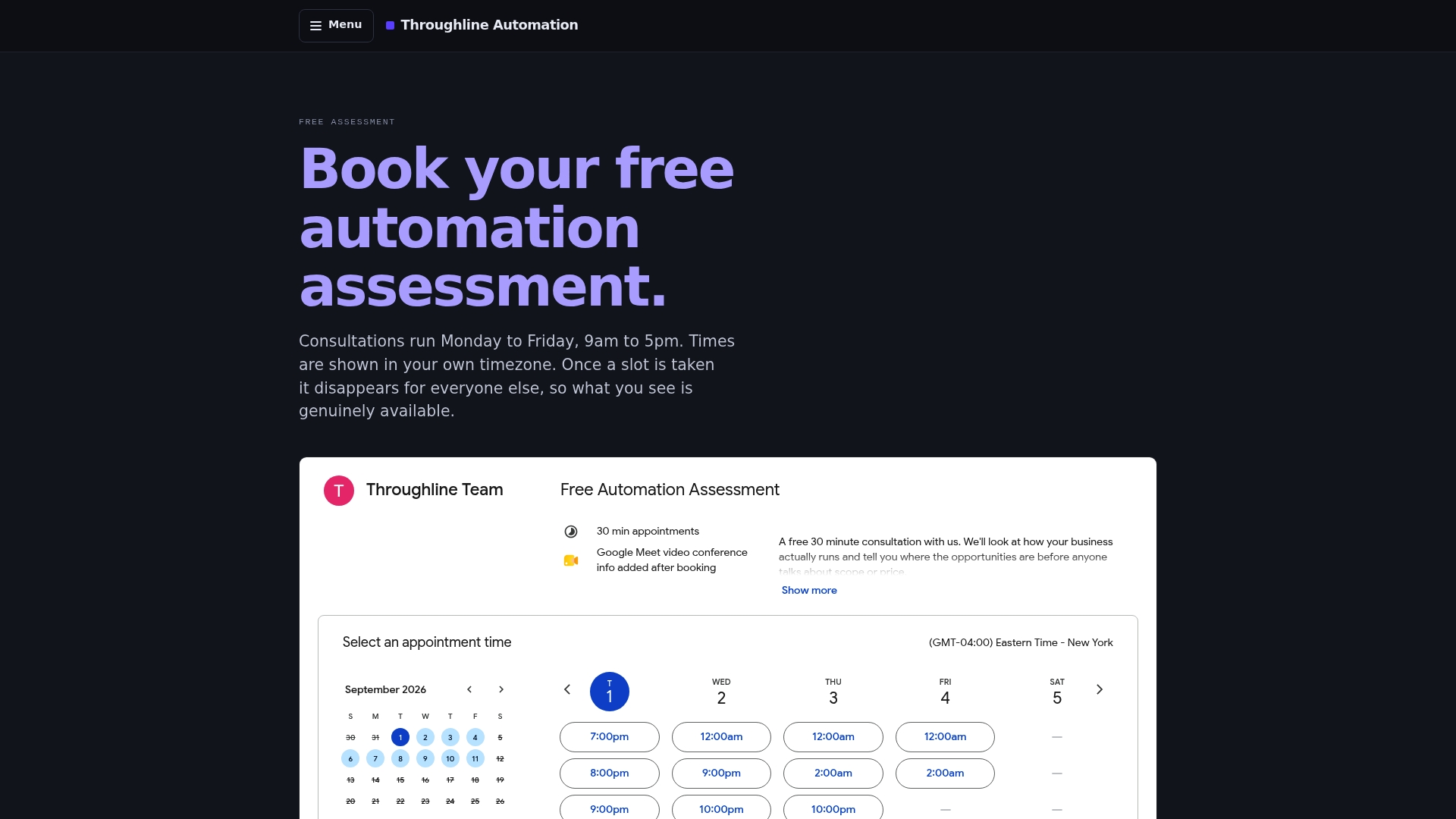
Throughline Automation runs a free 30-minute automation assessment built around exactly the discovery approach covered above: mapping your highest-cost manual processes and estimating what you’d get back before you commit a dollar. Unlike a generic strategy consult, this assessment focuses on integration with your current systems, not a rebuild, so there’s no forced migration and no lengthy software rollout to manage on top of your existing workload.
If you want to run the numbers yourself first, try the automation ROI calculator to estimate hours and AUD saved for your own team. When you’re ready to move past estimates, the 90-day transformation page explains exactly how delivery works from discovery through to handover. If your business needs broader organisational change alongside the automation build, The Strategy Haus supports program delivery and redesign work that complements this approach. Book your assessment and get a clear number on what manual work is actually costing you.
Sources
- AI productivity gains could deliver up to $116bn boost to Australia — EY
- AWS compliance — Australia & New Zealand
FAQ
How much does a business process automation consultant cost in Melbourne?
Costs depend on scope, but most consultants use fixed-price, time-and-materials, or retainer models, priced after a discovery phase maps your actual processes.
How long does a typical automation project take?
A focused first project, covering one to three high-volume processes, typically runs about 90 days from discovery through to handover and measured savings.
What’s the difference between RPA and full business process automation?
RPA is software robots copying manual steps a person currently does; broader business process automation includes RPA plus API integrations, document generation, and workflow redesign around your existing systems.
Do I need to replace my current software to automate my processes?
No. A good automation consultant, including Throughline Automation, builds on top of your existing systems through APIs and integrations rather than forcing a migration.
How do I measure ROI from a business automation project?
Multiply the hours a task currently takes by your loaded hourly labour cost to get an annual figure, then compare it against hours reclaimed after automation goes live.