For most mid-sized businesses, hiring an automation agency beats building an in-house team in year one. The exceptions: you handle highly sensitive data, or you’re committing to a multi-year automation roadmap with technical leadership already on staff. Everyone else should start with an agency and skip to the comparison below.
TL;DR:
- Most mid-sized businesses should start with an automation agency due to faster deployment times and comparable year-one costs, which range from A$120,000 to A$350,000 for initial systems.
- Agencies can deliver a first working system within 6 to 12 weeks, whereas in-house teams typically take 9 to 12 months to reach the same point, causing costly delays.
- A hybrid approach—agency-led development followed by internal operation training—is the most common and effective strategy for balancing speed, control, and long-term scalability.
- Agencies generally cost 40 to 60% less in the first year and reach production two to three times faster than building an internal team, especially when automation workload is steady or urgent results are needed.
- Clear contract controls for ownership, documentation, and handover are essential, regardless of whether choosing agency or in-house, to prevent knowledge loss and ensure ongoing operational independence.
Table of Contents
- Automation agency vs in-house automation team: the quick comparison
- What automation actually costs and how long it takes
- Five questions that tell you which path to take
- How the agency-to-in-house handover actually works
- Our take: stop treating this as a permanent choice
- Book your free automation assessment
- Sources
- FAQ
Automation agency vs in-house automation team: the quick comparison
Most leaders weighing an automation agency against an in-house automation team get stuck comparing salaries to invoices. That’s the wrong comparison. You need to look at total year-one cost, speed to a working system, and who actually carries the risk when something breaks.
An external automation partner typically delivers a first working system in 6 to 12 weeks. A new in-house hire, starting from scratch, usually needs 9 to 12 months to reach the same point. That gap alone changes the maths for most businesses.
Here’s how the two paths stack up across the dimensions that matter to a board or budget committee:
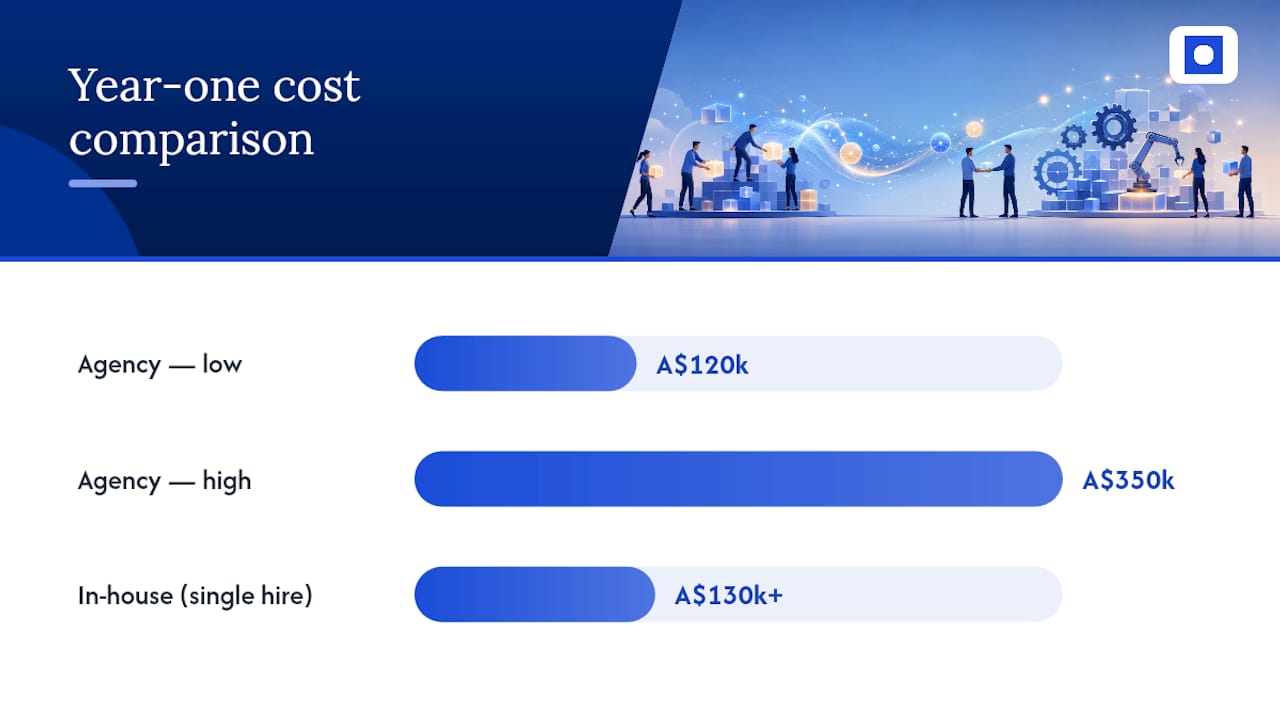
- Year-one cost: Agencies commonly land in the A$120,000 to A$350,000 range for a first system. A single in-house hire costs upwards of A$130,000 before anything is live, and that’s before tools and management overhead.
- Time to first results: Weeks for an agency, months for a new hire finding their feet.
- Expertise breadth: Agencies have built the same type of workflow for other clients, so they skip the mistakes a first-time hire will make. In-house staff know your business, but only after they’ve been there a while.
- Scalability: Agencies scale up or down with your workload. In-house teams need new hires every time volume grows.
- Risk and dependency: A single in-house automation specialist is a single point of failure. If they leave, the knowledge often leaves with them, unless documentation is enforced.
- Ownership and handover: Agencies should hand over full code, admin access and runbooks. In-house teams own everything from day one, for better or worse.
The pattern most mid-market businesses land on is a hybrid: an agency builds and ships the first systems, then an internal owner takes over daily operation once trained. It’s not either/or for most businesses. It’s agency first, in-house later, if the volume justifies it.
What automation actually costs and how long it takes
Before you present this to finance, get the numbers right. Guessing here is how projects get killed at budget approval.
In-house, year one, itemised:
That figure comes from real deployment data across 40+ Australian businesses, and it doesn’t include management time spent hiring, onboarding, and correcting early mistakes.
Agency pricing bands:
- First production system: A$120,000 to A$350,000 for a 12 to 20 week build.
- Ongoing managed service retainers: A$8,000 to A$25,000 per month.
- Consulting engagements generally cost 40 to 60% less in year one than an equivalent in-house build, and reach production 2 to 3 times faster.
Pro Tip: Add up the hours your team spends on manual data entry or invoice processing each week, multiply by your average hourly cost, and you’ll usually find the automation pays for itself faster than the hiring process alone would take.
There are hidden costs on both sides that rarely make it into the first quote. In-house builds carry the cost of a bad hire (rehiring, retraining, lost months). Agency work carries the cost of a poor handover if you don’t demand documentation in the contract.
The gap in numbers: an in-house build can cost the same as an agency engagement, but take three to six times longer to reach the same result. That delay itself has a cost. Every month without the automation is another month of paying staff to do the manual work by hand.
Five questions that tell you which path to take
Skip the debate. Answer these five questions honestly, and the right path becomes obvious.
- Do you need working results inside 90 days? If yes, lean agency. In-house hiring alone can eat that whole window.
- Is your automation workload steady enough to keep a specialist busy full time? If you only have a handful of workflows to fix, an in-house hire will be underused. If you’ve got a constant pipeline of processes to automate, in-house starts to make financial sense.
- Is your data too sensitive to hand to a third party? Health records, financial data or anything under strict privacy and residency obligations may require in-house control, or an agency contractually bound to Australian data residency.
- Do you already have technical leadership on staff? Without someone who can manage and direct an in-house hire, that hire will struggle. No technical leadership means you need an agency, at least at first.
- Is this a multi-year, core capability, or a one-off fix? A single problem points to an agency. A long-term automation roadmap across the business points toward eventually building internal capability.
Score it simply: three or more “yes” answers pointing to speed, sensitivity, or lack of leadership means agency. Three or more pointing to steady volume, existing leadership, and a multi-year plan means build in-house, or start hybrid.
Whichever path you choose, put these controls in the contract before you sign anything:
- Full IP transfer, including source code and configuration files.
- Written runbooks for every automated workflow.
- Admin access to every account and platform used.
- Documentation covering how to fix, extend or roll back each automation.
- Clear acceptance criteria for what “done” looks like, agreed before the project starts.
The most reliable hybrid structure works like this: the agency builds and ships the first systems, an internal staff member is trained to operate and maintain them, and the agency stays on a light advisory retainer for the trickier changes. You get speed now and control later, without gambling the whole budget on a new hire before you know if the automation even works.
How the agency-to-in-house handover actually works
A good handover isn’t an afterthought bolted onto the end of a project. It’s built into the delivery plan from day one. Some agencies run a defined 90-day transformation, with the handover written into the contract from the start, not negotiated after the fact.
The process runs in four stages:
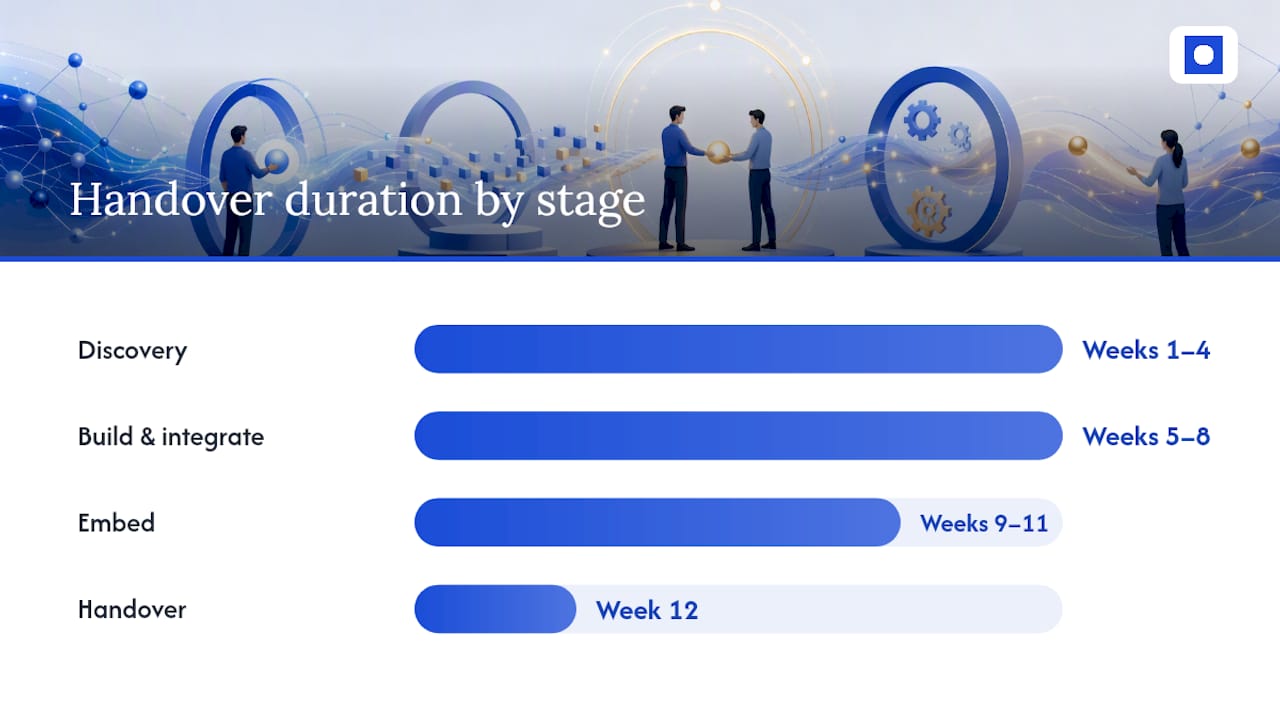
- Discovery (weeks 1 to 4): map the highest-cost manual workflows, agree acceptance criteria, and confirm what “success” looks like in hours saved and error reduction.
- Build and integrate (weeks 5 to 8): automations get built and connected to the software you already use, no rip-and-replace required, often leveraging the best no-code AI tools to accelerate development.
- Embed (weeks 9 to 11): your team gets trained on operating and adjusting the systems, with checkpoints at week 4, week 8 and week 12 to confirm capability transfer is on track.
- Handover (week 12): you receive full documentation, admin access, and training records. Nothing stays locked with the agency.
At each milestone, the client should own the outputs, not just view them. That means source code, platform logins, written runbooks, and a record of who on your team has been trained on what.
To accept the handover, measure four things: system uptime, hours of manual work removed per week, error rate compared to the old manual process, and whether your staff have completed training and can operate the system unassisted. A useful acceptance test is a 30-day window where your internal owner makes real changes to the system without agency help, and the outcomes hold up.
Our take: stop treating this as a permanent choice
Most advice on this topic treats “agency or in-house” as a one-time, permanent decision. It isn’t. The businesses getting the best results treat it as a sequence: agency first for speed and expertise, in-house later once volume and internal skill justify the cost.
The conventional advice oversells building a team early, as if headcount is a badge of seriousness about automation. It’s often the opposite. A rushed hire with no technical leadership above them burns a year and $130,000 before delivering anything.
What we’d prioritise first: demand documentation and full handover from day one, whichever path you choose. The businesses that get stuck aren’t the ones who picked agency or in-house. They’re the ones who never got the runbooks, the admin access, or the training records, and found out too late that the knowledge walked out the door with a contractor or an employee.
— Throughline Team
Book your free automation assessment
If the numbers above sound like your business, the next step is simple. An agency can be the practical middle ground between hiring blind and building an in-house team from scratch, handing you full ownership at the end, not a permanent dependency.
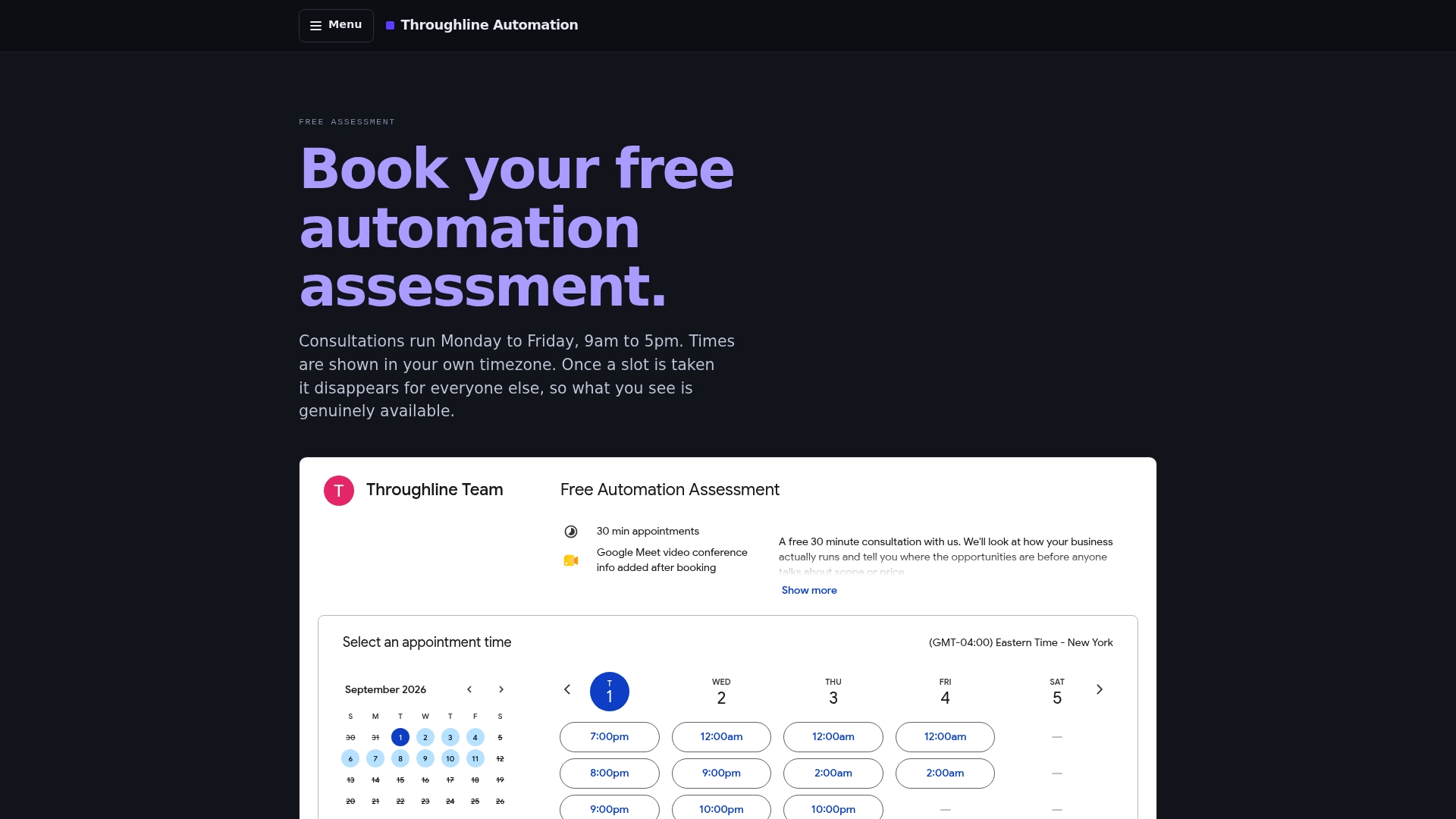
Every engagement runs on the same 90-day transformation process described above: map your highest-cost manual workflows, build and integrate the automations around your existing software, then hand over full documentation and control. It starts with a free 30-minute automation assessment. No obligation, no sales pitch. In that call, you’ll get:
- A shortlist of your highest-cost manual workflows, ranked by hours spent per week.
- A rough estimate of hours saved and the likely return on investment.
- A straight answer on whether your business needs an agency, an in-house hire, or a hybrid of both.
Book your free 30-minute automation assessment and find out what your manual processes are actually costing you.
Sources
- AI Consultant vs Building In‑House: Which Makes Sense for a $5M‑$50M Business — Mamba Strategic
- AI Consulting vs In‑House Team Australia | Neomeric
FAQ
What is an automation agency?
An automation agency is a business that designs, builds and integrates automated workflows for other companies, typically around software the client already uses. Unlike hiring staff, you pay for a project or retainer rather than a salary.
What is an in-house automation team?
An in-house automation team is made up of employees, usually developers or process specialists, who build and maintain automated workflows as a full-time role within the business. They carry deep knowledge of internal systems but take months to become productive.
Who is the largest automation company?
There’s no single dominant global provider in business process automation. The market includes large enterprise software vendors and thousands of specialist agencies serving specific industries and regions, including Australian firms like Throughline Automation that focus on mid-sized operational teams.
Which AI agent is best for automation?
There’s no single best tool. The right choice depends on your existing software stack, the complexity of the workflow, and whether it needs custom integration. This is exactly the kind of decision an automation agency is built to make for you, rather than leaving you to test tools yourself.
Is it cheaper to hire an agency or build an in-house automation team?
In year one, an agency is usually 40 to 60% cheaper than building an in-house team, and reaches production two to three times faster. In-house only becomes more cost-effective once workload volume is steady and continuous over multiple years.